Pages

Monday, September 8, 2014

Photos from the week 9/7/2014

      Since we don’t have banks, grocery stores, or hardware places, and we were running low in all the things you can find in them, Danforths and I had to go to Yaoundé, Cameroon, for supplies. Among other things, we got a replacement water pump for the one the lightning blew up.

There are two major camps for Central African refugees along the road to Yaoundé. This one stretches two kilometers!  

One day while planting trees at the international school in Yaoundé, I found a whip scorpion. Definitely one of the coolest bugs I have seen. 

During the week I was gone two swarms of bees moved in to some empty grass hives I had put in some trees. There is a plastic plate with a hole in the center, and the bees use that as the entrance. The rest is grass. 

It must be swarm season because this morning I found and captured another swarm. This makes three new hives in the last week! 

Friday, August 29, 2014

Hope for returning cooperatives

      It has been a little frustrating living in this country, Central African Republic (CAR), and not knowing what most of it looks like. Since it has been unsafe to travel the whole time I have been here, I have not been able to venture very far from Gamboula. This last month things have finally settled down enough that Roy and I felt it was okay to get out to see CEFA’s cooperatives. A few weeks ago we headed east to the town of Nasole, last week we went south to the village of Dede and this week we went north to Godowa. In each place we held a fruit tree seminar and brought trees from our nursery to the cooperatives.

      In the towns and villages to the east and south, life and landscape were normal for rural Central Africa. The trip north, however, was very different. A few months ago bands of Chadian rebels came and destroyed many villages, driving the inhabitants out to neighboring Cameroon. Since Gamboula is on a main road, and has a large population, it was not affected. But the drive (about 3 hours) from Gamboula north to Delopoko was on an over-grown and completely deserted road. Every house along the way had been abandoned and there were plants growing on and around them. Delapoko is a fairly large village where the local militias stood their ground and kept the town from being destroyed. It is here where refugees are returning. We met with 5 cooperatives in the church for a fruit tree seminar before heading out in to a freshly cleared field to plant an orchard of fruit trees. Seed for field crops, as well as tools, and food has been taken up there too. 

 
      Please continue to pray for the thousands of refugees in Cameroon and other countries, as well as those starting to return. Pray for peace and stability in the government as a new Prime Minister and cabinet has just been established. Next month UN peace keepers arrive and the French military force will leave, so pray that the transition will be smooth.

Sunday, August 17, 2014

Photos from the week 8/17/2014

     Last week was the first time Roy and I have been able to get out and go do a seminar with some of our cooperatives. We went east last and this week we went south. 8 of our cooperatives meet up at a town called Dede for a seminar on fruit trees. Despite getting stuck in the mud, and it raining a bunch during the day, we had a great turn out (about 85) and a fun time.

The truck got stuck in the mud coming off the ferry. After about an hour we were able to free it.

A group shot after the practical part of the seminar where we planted fruit trees.

      This week we had lightning strike our generator house at Somongue. Thankfully the generator seems to be ok, so work can continue at the garage. The bad news is that despite grounding rods and breakers, it blew up our electrical and water systems including; large inverter, battery bank, and water pump. Roy and I spent a day rewiring our houses with a whole new 12 volt system that is specific to each house. At this point neither the farm nor our two houses have water. This is the latest in a series of electrical setbacks/frustrations we have had during the last year.  

One of the 6 exploded batteries. 

The same storm that brought the lighting that hit the farm also brought hail. A rare sight in these parts.  


Sunday, August 10, 2014

Photos from the week 8/10/2014

One of my does gave birth to 9 babies! Today almost all of them have opened their eyes. 

Another army ant nest went up in flames this week. There are still scouting parties that are paying visits to Danforths and me, so there might still be another nest somewhere.

Before the flames discovered a chamber full of gas within the ant nest. 

One of the explosions when the fire made it to a chamber. 

Saturday, August 2, 2014

Photos from the week 8/3/2014

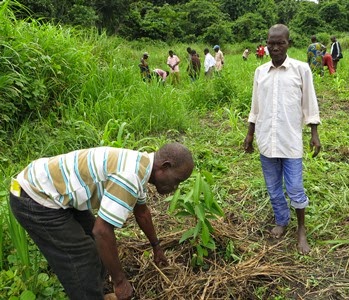
This week Roy and I had our first opportunity to go do a seminar at a village. Three cooperatives came together to learn about fruit trees. 

After theory, we went out in the field and planted 19 different kinds of fruit trees in one of the cooperatives fields. 

       I found the army ant nest that has been sending waves of soldiers to invade Danforths’ and my house. Roy and I dug into the nest, poured gasoline into a few of the tunnels and lit them on fire. The gas must have gotten all the way into the main chamber, because there were a few nice explosions. I went back later in the day and dug into the center of their mound, and found a huge hole about a meter deep and wide.  

Roy pouring gas down one of the army ant holes. 

Four fires going, one at each major entrance. From time to time there would be an explosion and a big puff of fire would fly out of one or more of these holes. I was unable to get a photo of that though.


It looks like it is that time of year again. Mangosteens and Rambutans. 

Sunday, July 27, 2014

Photos from the week 7/27/2014


Here are three barrels of cow peas that have been harvested from the farm. They will be distributed soon as seed. 

A few wind chimes I made of Bamboo

It is the time of year when people are harvesting peanuts! Fresh peanuts boiled are really addicting.
The Driver ants have been invading my house more frequently these nights. Saturday I found their home. Next step try to get rid of it. 

       I don’t have a camera any more except for the one on my phone. We don’t have cell reception on the farm, so I don’t often carry it with me. The quality of photos is also not great, so photos of the week will probably be a little different now.  

Thursday, July 10, 2014

Canoes, rain, rapids and hippos.

     In the United States many people use the 4th of July holiday as a time to welcome the summer and go camping. Although the 4th is not a holiday in CAR, one of the missionaries here, his sons, and I took a week over the 4th to enjoy the summer, and go on our own camping trip.
     The Turk boys go to school in Cameroon, and the parents spent the year there instead of here because of the unrest in CAR. The kids grew up in Gamboula and come back for vacations so they where all back for the summer. Benny the oldest just graduated high school and wanted to get one more good adventure in before heading to college.
      Since CAR is still not safe to do much adventuring in, we headed for Cameroon. At the border town we hopped on a crowded (people not being the only living creatures aboard) bus and headed to a town called Batouri. Here there is a bridge that crosses over the same river that flows by Gamboula. We purchased two canoes, 4 paddles, and set off downstream. 
The smaller boat coming through a narrow spot in the river. 
      I had printed out some satellite photos from Google Earth, but besides that we did not know how long it would take, and what obstacles awaited us around each bend. We did our best to connect with others along the river to ask for directions and advice.
     The first obstacles were the canoes. I am used to and am quite comfortable in flat bottom stand up canoes, like what I used in Congo. This whole area uses wide rounded hull sit down boats. They are more unstable, you are down lower, so you have less visibility, and take more effort to paddle.
My perch for the trip

      Second, the river was, in places quite narrow, and had rapids! Though I have shot rapids in a raft, I have not done it by canoe. From Google Earth I had been able to see where some of the rapids were, but could not tell the right places to pass. Lucky for us most of the rapids were only a few meters long, and mostly just intimidating.
While most of the time we went through rapids the camera was in a plastic bag, I was able to get photos of some from a distance. 

     Our first afternoon a storm caught and drenched us and all our things. We set up a wet camp, and since there was no dry firewood, we did not have a fire to cook over or chase the bugs away. Shortly after laying down in our soggy tent and clothes, driver ants invaded and we were forced to flee our tents. Needless to say none of us got any sleep that night.
     The river was really pretty, with forests on both sides. We saw countless kinds of birds, monitor lizards, playful otters, snakes, and large unidentified animals. The current was quite fast in places, and it was a nice ride.
Although we saw lots of animals and birds, most were moving fast, and so I was unable to get good photos of them. It was nice of this monitor lizard to pose for us as we went by. 

     By the end of the third day the river was joined by another smaller one and the scenery changed. The land was flatter now, with more grass growing on the sides. Hippo territory. There was a town we were able to stop at for much needed supplies. We had planned on catching and eating fish, but with all the rain, finding worms was impossible.
The two boats coming together for resupplying. 

     All through the fourth and fifth days we stirred up hippos on the banks. They would hear the boats coming, and crash through the brush before making huge splashes in the river. Others that were in the river already would just snort before ducking under. Most of them would just go under and stay there until we had passed, but a few of them went out in to the river after we had passed and surfaced again.
Our Camp site on the third night. 

     Our final day had the most rapids. One of our boats capsized after going over one of the falls, but we were able to right it and get all the water out fairly quickly. From Google Earth, I knew our biggest rapids were near the end of our trip. There was a maze of islands, with rapids all the way through them. Either we were paddling hard, or the river was flowing extra fast, because we hit the spot hours before we thought we would, and did not realize it was the spot until we had successfully made it through. Just before we entered into them, we found a fisherman and asked him directions through the mess. He told us and we went for it. The channels were very narrow, fast, and had lots of branches hanging out. Just like in those amusement park rides where you are going down a river and never hit anything you are going straight for, the current and some skill on the paddlers’ part, gave me the same feeling.
All of the travelers at the final destination 


     Since Gamboula is right on the border, we crossed over, and paddled right to the mission’s turbine house. It was a fun adventure and great to be with all the Turk guys..